SEO for Education: Complete Guide for Schools & Universities
Education is one of the most fragmented industries in SEO. A private K-12 school serving local families operates almost nothing like an EdTech SaaS company running 18-month enterprise sales cycles, and both are fundamentally different from an online course platform doing high-volume consumer SEO.
Most education SEO advice treats all of these the same. This guide does not.
It covers the 7 pillars of education SEO, academic seasonality and enrollment cycles, AI search visibility, international student recruitment, and how strategy differs across the 6 major education business models, from K-12 schools and universities to tutoring brands and EdTech companies.
Most education SEO advice treats all of these the same. This guide does not.
It covers the 7 pillars of education SEO, academic seasonality and enrollment cycles, AI search visibility, international student recruitment, and how strategy differs across the 6 major education business models, from K-12 schools and universities to tutoring brands and EdTech companies.

Table Of Content
- What is Healthcare SEO?
- Why is Healthcare SEO Important?
- How is Medical SEO Different from SEO for Other Markets?
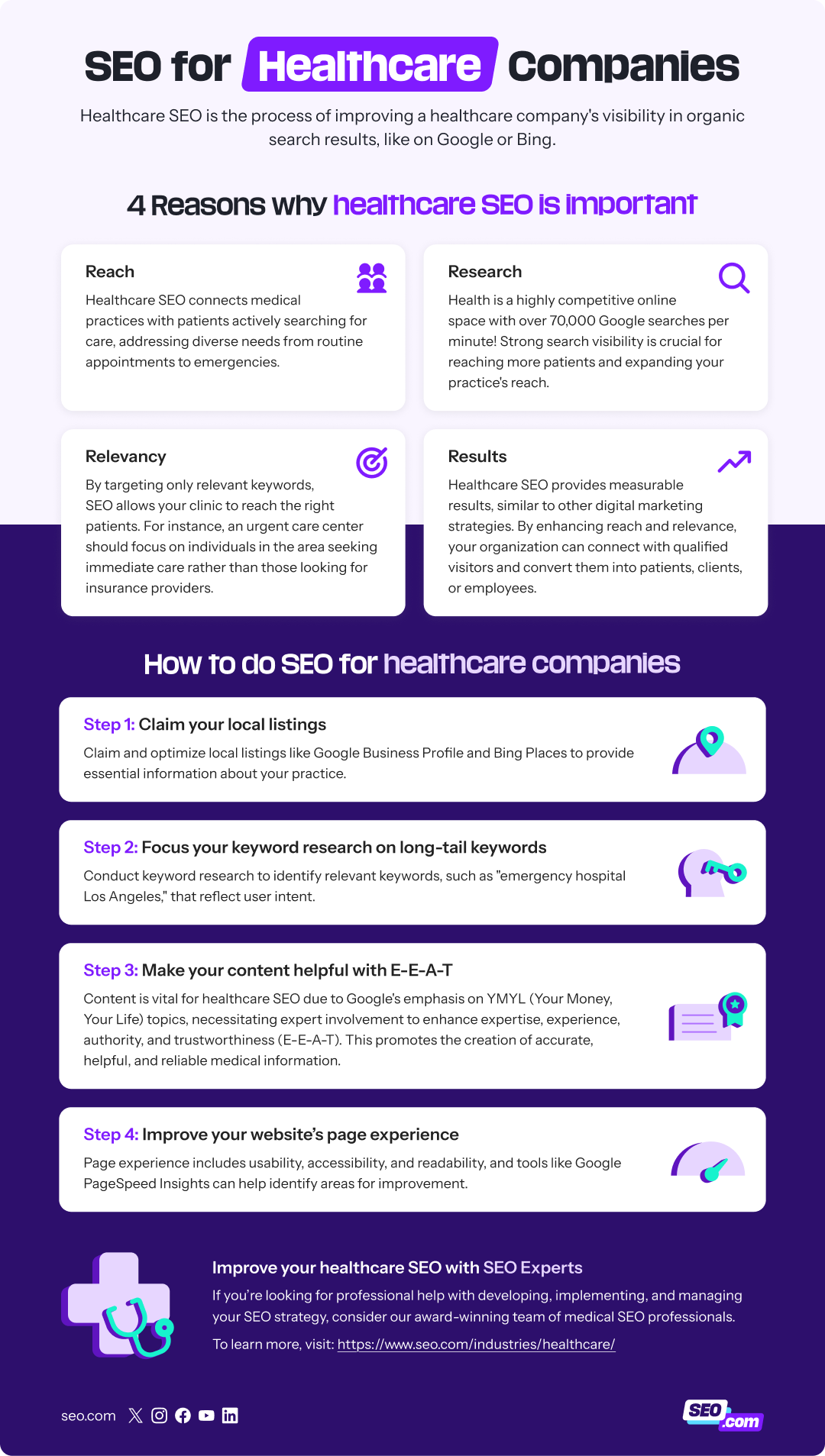
- How to Do SEO for Healthcare Companies
- Step 1: Claim Your Local Listings
- Step 2: Focus Your Keyword Research on Long-tail Keywords
- Step 3: Make Your Content Helpful with E-E-A-T
- Step 4: Improve Your Website’s Page Experience
- Step 5: Secure Your Site with HTTPS
- Step 6: Streamline Your Website Architecture
- FAQs About Outsourcing Medical SEO
SEO Services That Aren't Cookie Cutter
Get an SEO strategy that's tailored for your business, industry, and revenue goals.
Writers

Stephen Aloy
Lead SEO Consultant, WebFX
Stephen Aloy
Lead SEO Consultant, WebFX
Dive Deeper
Health Care
Lorem ipsum dolor sit amet, consectetur adipiscing elit. Ut elit tellus, luctus nec ullamcorper mattis, pulvinar dapibus leo.
Pest Control
Lorem ipsum dolor sit amet, consectetur adipiscing elit. Ut elit tellus, luctus nec ullamcorper mattis, pulvinar dapibus leo.
HVAC
Lorem ipsum dolor sit amet, consectetur adipiscing elit. Ut elit tellus, luctus nec ullamcorper mattis, pulvinar dapibus leo.
Manufacturing
Lorem ipsum dolor sit amet, consectetur adipiscing elit. Ut elit tellus, luctus nec ullamcorper mattis, pulvinar dapibus leo.
Dental
Lorem ipsum dolor sit amet, consectetur adipiscing elit. Ut elit tellus, luctus nec ullamcorper mattis, pulvinar dapibus leo.
Education
Lorem ipsum dolor sit amet, consectetur adipiscing elit. Ut elit tellus, luctus nec ullamcorper mattis, pulvinar dapibus leo.
Transportation
Lorem ipsum dolor sit amet, consectetur adipiscing elit. Ut elit tellus, luctus nec ullamcorper mattis, pulvinar dapibus leo.
Finance
Lorem ipsum dolor sit amet, consectetur adipiscing elit. Ut elit tellus, luctus nec ullamcorper mattis, pulvinar dapibus leo.
Local Business
Lorem ipsum dolor sit amet, consectetur adipiscing elit. Ut elit tellus, luctus nec ullamcorper mattis, pulvinar dapibus leo.
Franchise
Lorem ipsum dolor sit amet, consectetur adipiscing elit. Ut elit tellus, luctus nec ullamcorper mattis, pulvinar dapibus leo.
What Is Education SEO?
Education SEO is the process of optimizing educational institution websites so prospective students, parents, administrators, and decision-makers can find them through Google, AI search engines, voice search, and local Map Pack results.
The discipline applies to:
- K-12 schools
- Colleges and universities
- Online course providers
- Vocational schools
- Tutoring companies
- EdTech SaaS businesses
- Certification and training programs
Modern education SEO includes:
- E-E-A-T signals like faculty credentials and accreditation
- Program and course page optimization
- Local SEO for schools and campuses
- International student recruitment SEO
- Structured schema markup
- AI search visibility optimization
- Academic seasonality content planning
- Outcome and trust signal optimization
Unlike many industries, SEO for education changes substantially depending on the business model.
Dimension | K-12 Schools | Higher Education | Online Courses | EdTech SaaS |
Sales Cycle | 3–9 months | 6–18 months | Hours to days | 6–18 months |
Decision-Maker | Parents | Students + parents | Individual learner | Committee |
Deal Value | $15K–$45K/year | $20K–$70K+/year | $50–$500 | $50K–$500K+ |
Search Behavior | Local + research | National + international | Comparison-heavy | B2B research |
Primary Surfaces | Google + Maps | Google + AI | Google + reviews | Google + LinkedIn |
For broader foundations, see our SEO basics guide. Smaller educational organizations should also review our SEO for SMBs framework.
Why SEO for Education Matters in 2026
SEO for education matters because educational discovery is now heavily search-driven. Students, parents, and school administrators increasingly research institutions through Google, ChatGPT, Perplexity, Gemini, and AI-powered search experiences before making contact.
At the same time, paid acquisition costs continue rising across education categories.
Schools and educational brands that depend entirely on referrals, recruitment fairs, or paid advertising often face:
- Rising acquisition costs
- Lower long-term scalability
- Weak organic visibility
- Poor AI search presence
- Limited enrollment diversification
Three major trends make education SEO especially valuable.
1. Education Has Extremely High Customer Value
A single SEO-driven enrollment can produce substantial lifetime revenue.
- K-12 enrollment can generate $60,000 to $400,000+ over a student lifecycle
- Higher education enrollment may generate $80,000 to $300,000+
- EdTech SaaS contracts often exceed $200,000 in lifetime value
Those economics justify serious investment in education SEO services.
2. Academic Seasonality Creates Predictable Demand
Educational search behavior follows highly predictable annual cycles.
Examples include:
- AP exam demand spikes in May
- College application searches peak August through January
- Back-to-school queries surge in July
- Online course enrollments rise in January and August
Programs that prepare content months before these windows consistently outperform reactive competitors.
3. AI Search Is Reshaping Educational Discovery
Students now ask AI engines questions like:
- “What’s the best online MBA for working professionals?”
- “Compare private schools in Boston with strong arts programs.”
- “What are the best accredited cybersecurity bootcamps?”
Educational organizations optimized for AI visibility are gaining exposure across:
- Google AI Overviews
- ChatGPT recommendations
- Gemini summaries
- Perplexity citations
Institutions ignoring AI search visibility are already losing competitive ground.
The Academic Seasonality Framework
One of the biggest mistakes in education SEO is treating search demand as consistent year-round.
Educational search behavior follows predictable annual cycles tied to:
- Admissions deadlines
- Exam periods
- Enrollment windows
- Financial aid timelines
- School calendar events
Strong SEO for education aligns publishing schedules with these cycles.
Higher Education Application Cycle (August–January)
The Common Application opens August 1 each year, triggering large spikes in university research and application-related searches.
Key demand periods include:
- August–October: application research
- November: Early Action and Early Decision deadlines
- January: Regular Decision deadlines
SEO for universities works best when application-related content is published between May and July so pages are indexed before peak demand.
K-12 Admission Season (October–March)
SEO for schools serving K-12 markets depends heavily on seasonal enrollment cycles.
Searches for:
- “private schools near me”
- “best private schools”
- tuition-related queries
- school comparison searches
typically peak between October and January.
Schools should publish enrollment and admissions content several months ahead of demand.
Standardized Testing Cycles
SAT, ACT, AP, GRE, GMAT, LSAT, and other test-prep queries surge before exam dates.
Tutoring and test-prep companies should publish:
- study guides
- score improvement content
- exam FAQs
- prep schedules
- tutoring landing pages
2–3 months before major testing windows.
Back-to-School Season
Back-to-school demand peaks during June through August in the US.
This period creates strong visibility opportunities for:
- tutoring brands
- EdTech SEO campaigns
- educational apps
- parental support content
- school technology providers
Online Course Enrollment Windows
Online learning platforms typically see enrollment spikes during:
- January
- May–June
- August–September
Course launch and promotional content should be published 6–8 weeks before enrollment periods.
Off-Season SEO Opportunities
Lower-demand months like April and December are ideal for:
- technical SEO audits
- link-building campaigns
- evergreen educational content
- schema implementation
- site architecture improvements
Programs that prepare content ahead of seasonal demand consistently outperform reactive competitors.
The 7 Pillars of Education SEO
Every effective education SEO strategy relies on seven foundational pillars.
1. E-E-A-T Signals for Education
Education operates under strong YMYL (Your Money or Your Life) standards.
Google evaluates educational content heavily through E-E-A-T:
- Experience
- Expertise
- Authoritativeness
- Trustworthiness
Strong education SEO includes:
- Faculty bios with credentials
- Accreditation displays
- Graduation and placement data
- Published faculty research
- Transparent leadership pages
- Verified alumni outcomes
- Expert-reviewed educational content
Anonymous or low-authority educational content struggles to rank in 2026.
2. Program and Course Page Architecture
Most educational websites severely underbuild program pages.
Instead of a single “Programs” page, institutions should create:
- One page per degree
- One page per certification
- One page per course
- One page per academic track
- One page per vocational program
Strong program pages include:
- Curriculum details
- Faculty information
- Tuition data
- Career outcomes
- Admission requirements
- FAQs
- Schema markup
SEO for higher education especially depends on deep program architecture.
3. Local SEO for Schools and Campuses
Local SEO is critical for schools recruiting within geographic regions.
Strong local education SEO includes:
- Optimized Google Business Profiles
- NAP consistency
- Education-specific citations
- Campus-specific pages
- Parent and student reviews
- Local schema markup
SEO for schools often depends heavily on local Map Pack visibility.
4. International Student Recruitment Optimization
International student SEO is one of the most overlooked opportunities in higher education marketing.
Strong international recruitment SEO includes:
- Country-specific landing pages
- Visa-related content
- Accommodation guidance
- English proficiency information
- hreflang implementation
- International parent-focused content
Top source markets often include:
- India
- China
- Vietnam
- Nigeria
- South Korea
- Brazil
International enrollment frequently produces higher tuition value, making this an important investment area for SEO for universities.
5. Accreditation, Outcomes, and Trust Signals
Educational trust signals directly influence both rankings and conversions.
Important trust indicators include:
- Regional accreditation
- Programmatic accreditation
- Graduation rates
- Alumni outcomes
- Employment placement data
- Third-party rankings
- Student testimonials
- Faculty achievements
AI search engines also rely heavily on these signals when recommending institutions.
6. Schema Markup for Education
Education schema improves visibility in both search engines and AI systems.
Important schema types include:
- EducationalOrganization
- CollegeOrUniversity
- Course
- Person
- FAQPage
- Review
Structured data improves:
- Rich result eligibility
- AI citation frequency
- Course visibility
- Program indexing
Many institutions still use only basic Organization schema, leaving major visibility opportunities untapped.
7. AI Search Visibility for Educational Queries
AI-powered discovery is becoming central to education SEO.
Students increasingly ask conversational questions such as:
- “What’s the best online MBA for healthcare professionals?”
- “Which coding bootcamps are accredited?”
- “Compare top private schools in Chicago.”
To improve AI visibility, institutions need:
- Strong organic rankings
- Definition-first content
- Comprehensive schema
- Clear E-E-A-T signals
- Strong third-party citations
- Substantive student reviews
AI search visibility is now a core part of modern SEO for education.
Education SEO for Different Segments
Different education business models require fundamentally different SEO strategies.
1. K-12 Private and Public Schools
SEO for schools focuses heavily on:
- Local search visibility
- Parent decision-making
- Reputation management
- Enrollment-focused content
Strong strategies include:
- Google Business Profile optimization
- Open house and campus tour pages
- Parent testimonial content
- Tuition and financial aid pages
- Academic philosophy pages
- Student outcome stories
Most K-12 SEO campaigns range between $1,500 and $15,000 per month depending on school size and campus count.
2. Higher Education Institutions
SEO for universities involves:
- Long enrollment cycles
- High student lifetime value
- International recruitment
- Program-level content depth
- Faculty authority signals
High-performing university SEO strategies prioritize:
- One page per degree program
- Financial aid content
- Scholarship pages
- Admission process resources
- Faculty publications
- Outcome-focused landing pages
Enterprise university SEO programs often exceed $40,000 per month.
3. Online Courses and MOOC Platforms
Online course providers operate more like consumer SEO businesses.
Strong education SEO for online learning platforms includes:
- Course-specific landing pages
- Instructor authority pages
- Student review integration
- Comparison content
- Category hubs
- Mobile-first optimization
SEO for online learning platforms also depends heavily on review trust and conversion optimization.
4. EdTech SaaS Companies
SEO for EdTech companies is fundamentally B2B SEO.
Most EdTech SaaS providers sell through:
- school districts
- universities
- administrative committees
- procurement teams
Strong EdTech SEO strategies include:
- Role-specific content
- District implementation case studies
- FERPA and compliance content
- ROI calculators
- Integration documentation
- Procurement-focused resources
Many general agencies struggle with SEO for EdTech because the sales motion differs substantially from consumer education SEO.
5. Vocational and Trade Schools
Vocational schools compete heavily on career outcomes.
Strong SEO for education in trade industries emphasizes:
- Job placement rates
- Salary outcomes
- Certification timelines
- Employer partnerships
- Flexible scheduling
- Financial aid support
Local visibility also matters heavily because most vocational programs recruit regionally.
6. Tutoring and Test Prep Services
Tutoring SEO depends on:
- Test-specific pages
- Seasonal demand timing
- Instructor credibility
- Outcome data
- Local SEO visibility
Strong tutoring SEO strategies include:
- SAT pages
- ACT pages
- GRE pages
- AP exam hubs
- Score improvement case studies
- Local tutoring location pages
Seasonal timing is especially important in this segment.
How AI Search Engines Are Changing Educational Discovery
Educational research behavior is rapidly shifting toward AI search.
Students, parents, and administrators increasingly use:
- ChatGPT
- Gemini
- Perplexity
- Google AI Overviews
instead of relying only on traditional Google searches.
The queries themselves are also becoming more conversational.
Traditional search:
- “best online MBA”
- “private schools Boston”
AI-style search:
- “What’s the best online MBA for working healthcare professionals?”
- “Compare private K-8 schools in Boston with strong arts programs.”
To compete in these environments, educational institutions need:
Strong Organic Rankings
Most AI systems still rely heavily on top-ranking Google content.
Comprehensive Structured Data
Schema helps AI systems understand:
- programs
- faculty
- accreditation
- course structure
- institutional authority
Real E-E-A-T Signals
AI engines favor institutions with:
- credentialed faculty
- accreditation
- verified outcomes
- strong reputation signals
- clear institutional authority
Strong Third-Party Presence
Educational review and ranking platforms help reinforce trust.
Examples include:
- Niche
- GreatSchools
- Princeton Review
- US News
- Times Higher Education
Definition-First Content
Pages that clearly define programs early are more likely to appear in AI-generated summaries.
Strong Student Reviews
Detailed student reviews help AI systems identify authentic experience signals.
8 Education SEO Mistakes to Avoid
1. Using a Single Programs Page
Every major educational offering should have its own optimized page.
2. Publishing Anonymous Educational Content
Education content without credentialed authors weakens E-E-A-T.
3. Publishing Seasonal Content Too Late
Reactive publishing misses peak demand windows.
4. Creating Thin Location Pages
Campus pages should contain genuinely unique content.
5. Ignoring International Student SEO
Universities often miss high-value international search demand.
6. Hiding Accreditation and Outcome Data
Trust signals should be highly visible throughout the site.
7. Treating EdTech SEO Like Consumer SEO
SEO for EdTech requires B2B decision-maker content.
8. Ignoring AI Search Visibility
Educational discovery is increasingly happening through AI interfaces.
How to Choose an Education SEO Partner
Not every SEO agency understands education.
The best education SEO services combine:
- academic seasonality awareness
- E-E-A-T expertise
- enrollment funnel understanding
- AI visibility optimization
- segment-specific experience
When evaluating agencies, look for the following.
Education-Specific Experience
Ask for:
- university SEO case studies
- SEO for schools examples
- EdTech SEO campaigns
- enrollment growth metrics
Segment Expertise
SEO for higher education differs dramatically from SEO for EdTech or tutoring businesses.
Your partner should understand your specific model.
B2B Expertise for EdTech
EdTech companies need agencies experienced with:
- enterprise sales cycles
- ABM support
- procurement-focused content
- multi-stakeholder SEO
International Recruitment Experience
Universities targeting global enrollment should work with agencies experienced in:
- hreflang
- multilingual SEO
- country-specific search behavior
AI Search Awareness
Modern education SEO services should include:
- AI visibility monitoring
- citation tracking
- structured data optimization
- AI search strategy
Realistic Timelines
Education SEO compounds gradually.
Most programs see:
- early gains in months 3–6
- stronger enrollment impact in months 6–18
Any agency promising instant enrollment growth should be viewed cautiously.
Frequently Asked Questions
How long does education SEO take?
Most education SEO programs begin showing visibility improvements within 3–6 months.
Meaningful enrollment impact often appears between 6–18 months because educational buying cycles are seasonal and long-term.
How much do education SEO services cost?
Education SEO services typically range from:
- $1,500–$5,000/month for smaller schools
- $5,000–$15,000/month for vocational and regional organizations
- $5,000–$40,000+/month for universities
- $7,500–$50,000+/month for EdTech SaaS companies
Pricing depends on:
- geographic scope
- content depth
- enrollment goals
- technical complexity
- international targeting
What’s the difference between SEO for schools, universities, and EdTech?
SEO for schools focuses heavily on local visibility and parent decision-making.
SEO for universities involves long enrollment cycles, international recruitment, and program-specific content depth.
SEO for EdTech is typically B2B SEO targeting administrators, procurement teams, and institutional buyers.
How do schools improve student recruitment through SEO?
Schools improve enrollment visibility by:
- creating program-specific pages
- strengthening local SEO
- improving E-E-A-T signals
- publishing admissions content early
- showcasing student outcomes
- optimizing for AI search visibility
What is academic seasonality in education SEO?
Academic seasonality refers to recurring annual search trends tied to admissions, testing windows, enrollment cycles, and school calendars.
Programs that publish content ahead of these demand spikes usually outperform reactive competitors.
How do educational institutions appear in AI search results?
Institutions improve AI visibility through:
- strong Google rankings
- schema markup
- accreditation signals
- expert-authored content
- strong review profiles
- authoritative program pages
Should EdTech companies focus on B2B or consumer SEO?
Most EdTech SaaS companies need B2B SEO because they sell to districts, schools, and universities.
Consumer-focused EdTech products targeting learners or parents typically require B2C SEO strategies instead.
Your Next Steps
You now have the strategic foundation for modern SEO for education.
The next step is identifying which education segment your organization fits into and evaluating your current visibility against the seven core pillars covered above.
Recommended next resources:
- SEO basics
- Keyword research
- Technical SEO
- On-page SEO
- Off-page SEO
- SEO content strategy
- Local SEO
- AI and SEO
- AEO and GEO optimization
- SEO KPIs and reporting
- Lead generation SEO