
How to Improve SEO for B2B Companies
Healthcare SEO involves optimizing your website to rank in search results for related queries. It often focuses on local SEO tactics, targeting relevant keywords, and creating high quality content.
Written by Sarah Berry and WebFX Marketing Experts Last Updated October 30, 2025

Table Of Content
- What is Healthcare SEO?
- Why is Healthcare SEO Important?
- How is Medical SEO Different from SEO for Other Markets?
- How to Do SEO for Healthcare Companies
- Step 1: Claim Your Local Listings
- Step 2: Focus Your Keyword Research on Long-tail Keywords
- Step 3: Make Your Content Helpful with E-E-A-T
- Step 4: Improve Your Website’s Page Experience
- Step 5: Secure Your Site with HTTPS
- Step 6: Streamline Your Website Architecture
- FAQs About Outsourcing Medical SEO
SEO Services That Aren't Cookie Cutter
Get an SEO strategy that's tailored for your business, industry, and revenue goals.
Key Takeaways
- Healthcare SEO (medical SEO) drives measurable growth from high‑intent health searches (over 70,000 on Google), accelerating patient acquisition, talent attraction, and investor interest.
To turn that demand into rankings and patients: - Target long‑tail, intent- and location-specific keywords (e.g., “emergency hospital los angeles”) using Ahrefs/Semrush/Keywords Everywhere; balance relevance, volume, and competitiveness by service line.
- Win local SEO: claim/optimize Google Business Profile and Bing Places with consistent NAP, services, photos; keep hours/updates current and manage reviews (no incentives) to rank in the map pack.
- Nail technical and compliance essentials: improve page experience (usability, accessibility, readability), secure with HTTPS/SSL, streamline site architecture, and stay HIPAA‑compliant—consider experienced medical SEO partners.
- Build E‑E‑A‑T for YMYL topics: have clinicians author/review content; showcase provider bios, accreditations, testimonials, and reviews to earn trust and rank.
Get started with healthcare SEO to grow your medical practice, dermatology, or healthcare center. Medical SEO can attract patients, talent, investors, and more through the web. Learn how to do SEO for healthcare (or get professional help with medical SEO services) in this definitive guide!
What is healthcare SEO?
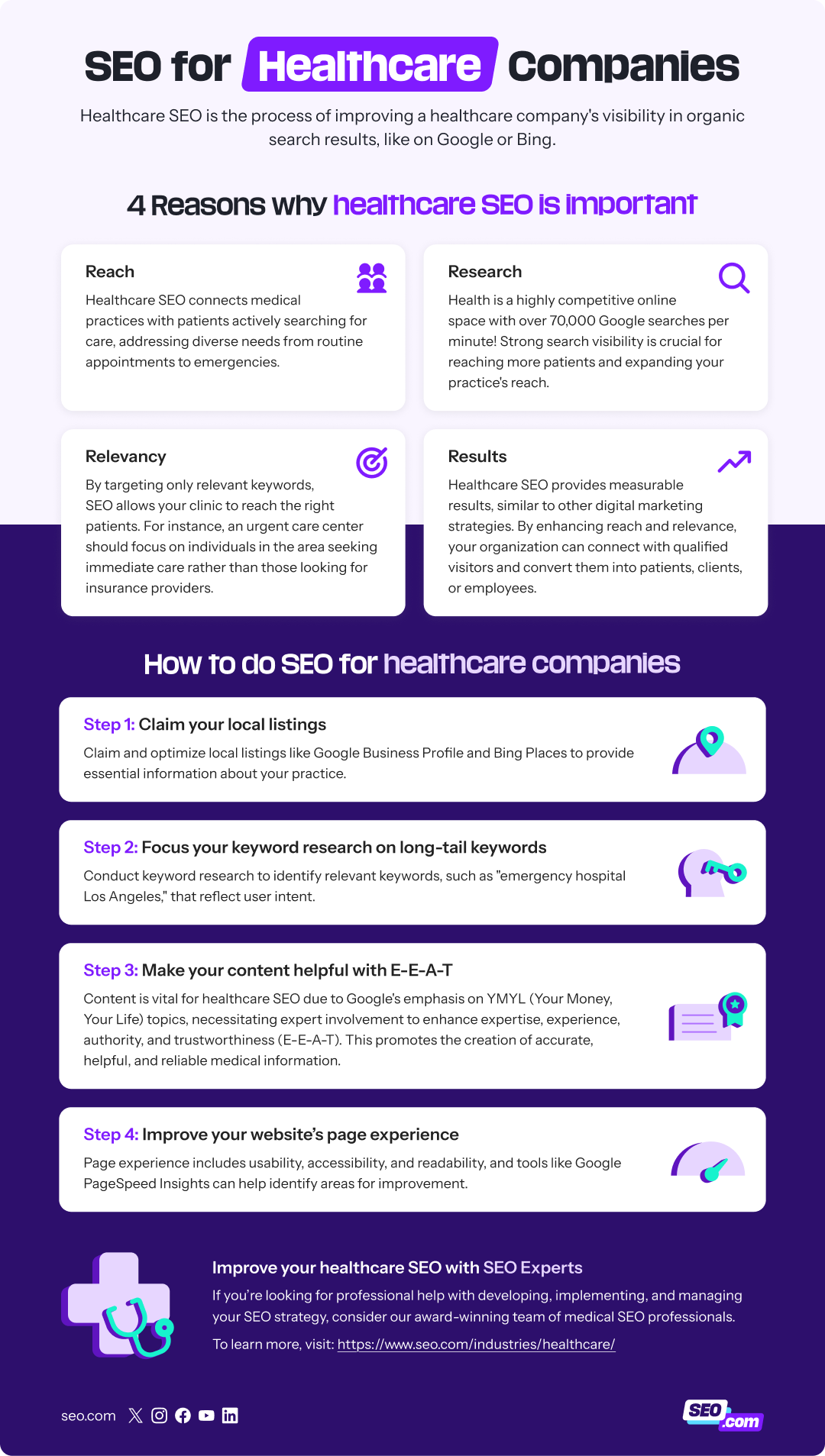
Why is healthcare SEO important?
Relevancy: Through keyword targeting, your center can focus on the people most important to your center. For example, if you’re an urgent care center, you’ll likely want to reach people in your area searching for immediate care vs. people in your area looking for an insurance provider.
Research: Health is one of the most popular niches in search. Google alone receives over 70,000 health related queries each minute! Building up your organization’s visibility in search will allow you to reach more people and provide more care.
Results: Healthcare SEO delivers real, measurable results like other digital marketing strategies. Through its reach and relevancy, your organization can reach the most relevant and qualified users and convert them into patients, clients, or employees.
How is medical SEO different from SEO for other markets?
“Any content — not just unhelpful content — on sites determined to have relatively high amounts of unhelpful content overall is less likely to perform well in Search, assuming there is other content elsewhere from the web that’s better to display.”
Google Search Central
How to do SEO for healthcare companies
- Claim your local listings
- Focus your keyword research on long-tail keywords
- Make your content helpful with E-E-A-T
- Improve your website’s page experience
- Secure your site with HTTPS
- Streamline your website architecture
Step 1: Claim your local listings
- Name
- Address
- Phone Number
- About
- Website URL
- Photos
- Services [if applicable]
Ongoing, you’ll want to complete the following:
- Update your hours, like for holidays or sudden closures
- Share your updates, like a new wing opening or a new service being offered
- Monitor your reviews, like on a daily or weekly basis
Step 2: Focus your keyword research on long-tail keywords
Step 3: Make your content helpful with E-E-A-T
Step 4: Improve your website’s page experience
- Usability
- Accessibility
- Readability
- Fixing mobile-friendly issues
- Improving color contrast between background and text colors
- Removing unused scripts
In most cases, you’ll need the help of a web developer to fix these issues. If you’re working with a full-service SEO agency (like SEO.com), they’ll have in-house web developers to develop the fixes for you — saving you the hassle of sourcing the time internally.
Step 5: Secure your site with HTTPS
Step 6: Streamline your website architecture
FAQs about outsourcing medical SEO
What are healthcare SEO services?
What do healthcare SEO services include?
- On-page optimizations, like keyword research and content creation
- Off-page optimizations, like backlink and local listing acquisition
- Technical optimizations, like page experience and page speed improvements
They should also include reporting, allowing you to see SEO’s impact on your medical practice or healthcare center. Ideally, you’ll want an SEO partner to measure the SEO metrics that matter most to your business like patients acquired or hired talent.
How much do healthcare SEO services cost?
Writers

Stephen Aloy
Lead SEO Consultant, WebFX
Stephen Aloy
Lead SEO Consultant, WebFX
Dive Deeper
Health Care
Lorem ipsum dolor sit amet, consectetur adipiscing elit. Ut elit tellus, luctus nec ullamcorper mattis, pulvinar dapibus leo.
Pest Control
Lorem ipsum dolor sit amet, consectetur adipiscing elit. Ut elit tellus, luctus nec ullamcorper mattis, pulvinar dapibus leo.
HVAC
Lorem ipsum dolor sit amet, consectetur adipiscing elit. Ut elit tellus, luctus nec ullamcorper mattis, pulvinar dapibus leo.
Manufacturing
Lorem ipsum dolor sit amet, consectetur adipiscing elit. Ut elit tellus, luctus nec ullamcorper mattis, pulvinar dapibus leo.
Dental
Lorem ipsum dolor sit amet, consectetur adipiscing elit. Ut elit tellus, luctus nec ullamcorper mattis, pulvinar dapibus leo.
Education
Lorem ipsum dolor sit amet, consectetur adipiscing elit. Ut elit tellus, luctus nec ullamcorper mattis, pulvinar dapibus leo.
Transportation
Lorem ipsum dolor sit amet, consectetur adipiscing elit. Ut elit tellus, luctus nec ullamcorper mattis, pulvinar dapibus leo.
Finance
Lorem ipsum dolor sit amet, consectetur adipiscing elit. Ut elit tellus, luctus nec ullamcorper mattis, pulvinar dapibus leo.
Local Business
Lorem ipsum dolor sit amet, consectetur adipiscing elit. Ut elit tellus, luctus nec ullamcorper mattis, pulvinar dapibus leo.
Franchise
Lorem ipsum dolor sit amet, consectetur adipiscing elit. Ut elit tellus, luctus nec ullamcorper mattis, pulvinar dapibus leo.