
SEO for Dentists: The Complete 2026 Guide to Dental SEO

Table Of Content
- What Is Dental SEO?
- Why Dentists Need SEO in 2026
- How Dental SEO Is Different from Generic SEO
- The 7 Pillars of Dental SEO
- Local SEO for Dental Practices (Deeper Section)
- SEO for Dental Specialties
- SEO for Dental Practices on AI Search Engines
- 8 Dental SEO Mistakes to Avoid
- How to Choose a Dental SEO Partner
- Your Next Steps
SEO Services That Aren't Cookie Cutter
Get an SEO strategy that's tailored for your business, industry, and revenue goals.
What Is Dental SEO?
Dental SEO is the practice of optimizing a dental practice’s website, Google Business Profile, and online presence so that patients searching for dental services can find, trust, and contact the practice. It includes local SEO tactics specific to healthcare, on-page optimization for service-specific keywords, review management, and increasingly, optimization for AI search engines like ChatGPT and Gemini.
Dental SEO is a specialized branch of SEO. While it shares the same foundations as any other industry (covered in our SEO basics, on-page SEO, technical SEO, and off-page SEO guides), dental practices face a unique combination of challenges:
- Hyper-local intent: Almost every dental search has a location attached, even when the searcher does not type their city. Google interprets “dentist” as “dentist near me” almost universally.
- YMYL category: Dentistry is a Your Money or Your Life topic in Google’s quality framework, which means trust signals (E-E-A-T) get weighted heavily.
- Insurance and procedure complexity: Patients search for highly specific terms (“invisalign provider that takes Aetna,” “emergency tooth extraction”) that require service-specific pages.
- Patient psychology: Choosing a dentist is a high-trust decision. Reviews, credentials, and a professional online presence matter more than in most industries.
This page focuses specifically on dentistry. For broader medical practice SEO (physicians, clinics, hospitals, specialists outside of dentistry), see our healthcare SEO page.
Why Dentists Need SEO in 2026
Dentists need SEO because the patient acquisition pipeline now starts with a search engine, not a phone book or a billboard. A practice that does not appear in the first three positions on Google or in the local map pack effectively does not exist for the majority of new patients in its service area.
The patient acquisition math is straightforward. According to recent click-through data, 27.6% of searchers click the top organic result, while only 2.4% click position 10. More than 54% of searchers click one of the top three results combined. A practice ranking on page two of Google for its primary keywords captures almost zero new patients from search.
The economics also favor SEO over alternatives. A patient acquired through Google Ads typically costs between $50 and $300 in click spend, and that cost recurs for every new patient. A patient acquired through SEO costs nothing per click, and rankings continue producing patients month after month with no per-acquisition fee. The upfront investment is real, but the per-patient cost approaches zero over time.
For practices comparing budget options, our breakdown of SEO services pricing covers what dental SEO typically costs at different practice sizes.
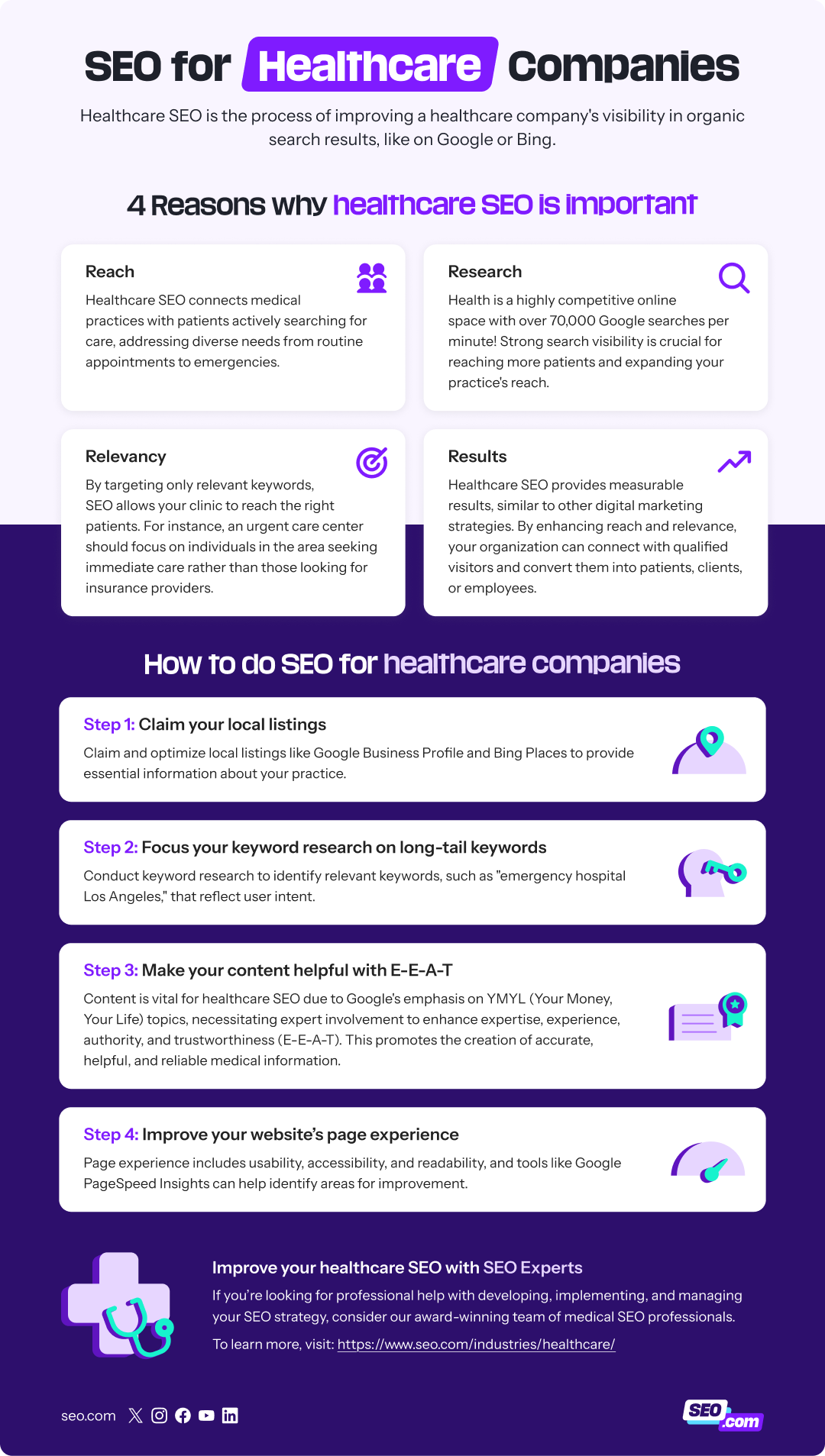
How Dental SEO Is Different from Generic SEO
Most SEO advice on the internet is written for ecommerce stores, SaaS companies, or general local businesses. Dental SEO has its own dynamics:
- Local SEO is the foundation, not a side activity: For most dental practices, ranking in the local map pack matters more than ranking in the regular organic results. Google Business Profile becomes the most important asset in the entire SEO program.
- Specialty matters for keyword strategy: A general dentist, an orthodontist, and an oral surgeon should all target very different keyword sets despite sharing the broader category.
- Reviews are a primary ranking factor: In most industries, reviews matter for conversions but only loosely for rankings. In dentistry, review count, review velocity, and average rating directly influence map pack rankings.
- YMYL E-E-A-T standards apply: Google holds dental websites to a higher standard for expertise and trust signals than it does for, say, a coffee blog. Author credentials, professional certifications, and clear practice information are not optional.
HIPAA shapes the website: Patient privacy regulations affect what content can be published, how forms are built, and how data flows between systems.
The 7 Pillars of Dental SEO
Every effective dental SEO program rests on these seven pillars. Skip any one of them and the others underperform.
1. Local SEO and Google Business Profile
Local SEO is the practice of optimizing your online presence for searches with local intent, which describes nearly every dental query. Google Business Profile is the single most important asset in dental SEO.
A complete, correctly categorized profile with high-quality photos, accurate hours, services lists, regular posts, and a strong review profile can put a practice in the local map pack within weeks.
The map pack typically captures more new patient inquiries than the regular organic results combined for dental searches. Our local SEO guide covers the full setup process.
2. On-Page SEO for Dental Services
On-page SEO for dental practices means creating dedicated pages for each major service, optimized for the specific keywords patients use. A general dentist should have separate pages for cleanings, fillings, crowns, root canals, extractions, dental implants, and emergency services.
Each page targets its own keyword cluster (“dental implants in [city],” “emergency dentist [city]”) and addresses the specific questions patients have about that procedure. One generic “services” page that mentions everything cannot rank for any of these terms competitively.
3. Reviews and Reputation Management
Reviews are both a ranking signal and a conversion driver in dental SEO. Practices with hundreds of authentic four-and-five-star reviews on Google, Healthgrades, Yelp, and Zocdoc consistently outrank practices with sparse review profiles, even when the rest of their SEO is weaker.
Active review generation (asking satisfied patients to leave reviews after appointments) and review response (replying professionally to both positive and negative reviews) are continuous activities, not one-time tasks.
4. Technical SEO and HIPAA-Compliant Infrastructure
Technical SEO ensures your website is fast, mobile-friendly, secure, and easy for search engines to crawl. For dental practices, this layer also has to be HIPAA-compliant, which affects how forms are built, how data is transmitted, and how third-party scripts are loaded.
SSL is non-negotiable. Page speed matters because patients searching on phones abandon slow pages quickly. Schema markup specific to dental practices (LocalBusiness, Dentist, MedicalBusiness) helps both Google and AI engines understand the practice context. Our technical SEO guide covers the full foundation.
5. Content Marketing for Dental Practices
Content marketing for dentists means publishing helpful, accurate content that answers the questions patients are already searching for.
Blog posts and educational pages on topics like “what to expect during a root canal,” “how much do dental implants cost,” “is teeth whitening safe during pregnancy,” and “when does my child need an orthodontist” attract patients early in their decision process and establish the practice as a trusted resource.
Content has to be medically accurate, written or reviewed by clinical staff, and aligned with E-E-A-T standards. Our SEO content guide covers the framework.
6. Backlinks and Healthcare Authority
Backlinks from local publications, healthcare directories, dental associations, and partner practices build the authority signals that drive long-term ranking growth. For dental practices, authority does not come from random link-building campaigns.
It comes from being listed in healthcare-specific directories (Healthgrades, Vitals, Doctor.com, ADA Find-a-Dentist), being mentioned in local news coverage, sponsoring community events, and earning links from professional associations. Our off-page SEO guide covers the broader principles.
7. AI Search Optimization
AI search optimization is the practice of structuring content so it gets cited inside AI-generated answers from ChatGPT, Gemini, Perplexity, and Google AI Overviews.
Patients are increasingly asking AI assistants for dental recommendations directly: “best pediatric dentist in Austin,” “find me a dentist that takes my insurance,” “what is the difference between Invisalign and traditional braces.” Practices that show up in those AI answers capture a fast-growing share of patient inquiries. We cover the playbook in our guides to AI and SEO, AEO, and GEO.
Local SEO for Dental Practices (Deeper Section)
Because local SEO is the most important pillar for dental practices, it deserves a closer look. The five elements that drive map pack rankings:
Google Business Profile completeness: Fill in every available field. Add the primary category (Dentist, Orthodontist, Oral Surgeon as appropriate) and every relevant secondary category (Cosmetic Dentist, Pediatric Dentist, Emergency Dental Service). List every service the practice offers using GBP’s services feature. Add high-quality photos of the office, the team, and procedures (where appropriate). Post regular updates, offers, and announcements through GBP Posts.
NAP consistency across the web: Your practice’s Name, Address, and Phone number must appear identically on every directory and listing where it is mentioned. Inconsistencies (different phone numbers, missing suite numbers, varied business name spellings) confuse search engines and weaken local rankings.
Healthcare-specific directories: General directories like Yelp matter, but healthcare-specific directories carry more weight in dental SEO. Build complete profiles on Healthgrades, Zocdoc, Vitals, Doctor.com, WebMD, and the ADA Find-a-Dentist directory. Each profile is both a citation and a potential traffic source.
Review velocity and response: Google looks at how recently reviews were posted, not just the total count. A practice with 50 reviews from the last 12 months ranks better than one with 200 reviews all from three years ago. Build a system for asking every satisfied patient to leave a review within 48 hours of their visit. Respond to every review, positive or negative, within a few days.
Hyperlocal content: Beyond a general “About” page, create pages for each neighborhood or area you serve. A practice in Austin might have separate pages for “South Austin Dentist,” “Round Rock Dentist,” and “Cedar Park Dentist,” each targeting that specific local intent.
SEO for Dental Specialties
General SEO advice does not work equally well across every dental specialty. Each specialty has its own keyword landscape, patient psychology, and competitive dynamics.
General Dentistry
General dentists target the broadest keyword set: “dentist [city],” “dental cleaning [city],” “family dentist near me,” “emergency dentist [city],” and procedure-specific terms like fillings, crowns, and root canals. The competition is highest, but the search volume is also the largest. General dentistry SEO leans heavily on local SEO and a wide network of service-specific pages covering every procedure offered.
Orthodontics
Orthodontic SEO targets a more specific patient mindset. Keywords include “orthodontist [city],” “Invisalign [city],” “clear aligners,” “braces for adults,” and “kids orthodontist.” Patients researching orthodontics are usually deep in the consideration phase and read extensively before booking. Long-form educational content (Invisalign vs traditional braces, treatment timeline expectations, cost transparency) drives both rankings and conversions. The Invisalign provider directory is a high-value citation for this specialty.
Oral Surgery
Oral surgery SEO covers wisdom tooth extractions, dental implants, jaw surgery, and complex extractions. Keywords skew toward procedure-specific intent (“dental implants [city],” “wisdom teeth removal,” “all-on-4 dental implants near me”). Cost transparency content performs well because oral surgery is high-priced and patients research extensively. Strong before-and-after content (where HIPAA permits) and procedure videos help both rankings and trust.
Pediatric Dentistry
Pediatric dental SEO targets parents searching for their child’s first dentist or for ongoing care. Keywords include “pediatric dentist [city],” “kids dentist near me,” “children’s dental sedation,” and “first dentist appointment for a toddler.” Content needs to address parent concerns: anxiety, sedation safety, insurance coverage, and child-friendly office environments. Trust signals matter even more here than in other dental specialties because parents make extra-cautious decisions for their children.
Cosmetic Dentistry
Cosmetic dental SEO covers veneers, teeth whitening, smile makeovers, dental bonding, and gum contouring. Keywords often include aspirational phrases (“smile makeover,” “Hollywood smile”) alongside procedure-specific terms (“porcelain veneers cost,” “professional teeth whitening”). Visual content matters most in this specialty. High-quality before-and-after galleries (with patient consent), Instagram-friendly photography, and detailed cost transparency drive results.
Periodontics and Endodontics
These specialties target referral-driven keywords (“periodontist [city],” “gum disease treatment,” “endodontist [city],” “root canal specialist”). Many patients reach these specialists through referrals from general dentists, but search still matters for second opinions, insurance verification, and specialty-specific procedures. Content focused on educating patients about gum disease, root canal procedures, and treatment alternatives builds authority and captures research-stage visitors.
SEO for Dental Practices on AI Search Engines
A growing share of dental queries now happen on AI search engines instead of Google. A patient might ask ChatGPT “what is the best pediatric dentist in Austin,” ask Perplexity “which dentists in my area accept Cigna PPO,” or get an AI Overview when searching Google for “Invisalign cost.”
To rank in these AI surfaces, a dental practice needs:
- Strong organic Google rankings: Roughly 73% of websites cited inside Google AI Overviews also rank in the top 10 organic results. Traditional SEO is the foundation for AI visibility.
- Schema markup for healthcare entities: Implement Dentist, MedicalBusiness, LocalBusiness, and FAQPage schema. Gemini in particular leans heavily on structured data for healthcare queries.
- E-E-A-T signals: Author credentials on every clinical content piece, prominent display of practice certifications and team bios, and clear sourcing for any medical claims.
- Citations across publications and directories: AI engines cross-reference brand mentions across the web. A practice covered in local news, listed on healthcare directories, and reviewed on multiple platforms is far more likely to be cited than one with thin off-site presence.
- Definition-first content structure: Pages that open each section with a clear, citable answer paragraph get extracted into AI answers more reliably than pages that bury the answer.
8 Dental SEO Mistakes to Avoid
These are the issues we find most often when auditing dental practice websites. Each one is fixable, and each one costs patients.
- One generic services page: A single “Services” page covering cleanings, fillings, implants, Invisalign, and emergency dentistry cannot rank competitively for any of those terms. Every major service deserves its own dedicated page.
- Inconsistent NAP across directories: Different phone numbers, address variations, or business name spellings on Yelp versus Healthgrades versus your website confuse search engines and weaken local rankings.
- No active review management: Sporadic reviews and no responses signal an inactive practice. Build a system for asking every satisfied patient to review within 48 hours of their appointment.
- Ignoring AI search: Treating ChatGPT, Gemini, and Perplexity as irrelevant to dentistry is a mistake. Patient queries are increasingly going to these surfaces, and the practices showing up first will own that traffic.
- Generic content with no local angle: A dental blog post titled “5 Tips for Healthy Teeth” will never rank. The same post titled “5 Tips from [Practice Name] for Healthy Teeth in [City]” with genuine local context performs far better.
- Slow, mobile-unfriendly websites: Patients search overwhelmingly on phones. Sites that take more than three seconds to load lose visitors before content even appears.
- Missing or wrong schema markup: Dental websites without LocalBusiness, Dentist, and FAQPage schema leave significant ranking opportunity on the table, especially for AI engines.
- Set-and-forget Google Business Profile: GBP is a living asset. Practices that update photos quarterly, post weekly, and add new services as they launch outperform those that set up the profile once and never touch it again.
How to Choose a Dental SEO Partner
If you decide not to run dental SEO in-house, the partner you choose matters as much as the work itself. Look for:
Healthcare-specific experience: A dental SEO partner should be able to point to dental practice case studies, not just generic local business results. Dental SEO requires familiarity with HIPAA, ADA standards, and the specific keyword landscape for each specialty. Generalist agencies often struggle with the dental-specific nuances.
Transparent reporting: Monthly reports should show specific metrics: keyword rankings, Google Business Profile insights, review growth, organic traffic, and (most importantly) new patient inquiries attributed to organic search. Agencies that hide behind vanity metrics rarely produce real results.
Local SEO depth: Dental practices live or die by local SEO. The partner should treat Google Business Profile, citation building, and review management as core deliverables, not afterthoughts.
AI search awareness: In 2026, any dental SEO partner that does not have a clear approach to AI search visibility (ChatGPT, Gemini, Perplexity citations) is working from an outdated playbook.
Honest timelines: Real dental SEO produces early lift between months three and six, with compounding returns building through year one and beyond. Partners promising first-page rankings in 30 days are either selling paid ads, using black-hat tactics that will eventually backfire, or misrepresenting timelines.
Reasonable pricing: Dental SEO programs typically range from $1,500 to $7,500 per month depending on practice size, market competition, and service depth. See our SEO services pricing page for a fuller breakdown, or explore our managed SEO services and local SEO services to see how we structure dental engagements.
Your Next Steps
You now have the dental SEO foundation. The fastest way to put this knowledge to work is to start with a Google Business Profile audit, then work through the rest of the SEO library:
- Read SEO basics for the broader context
- Cover local SEO services since local is the most important pillar for dental
- Review on-page SEO and technical SEO for the foundational layers
- Master keyword research so your service pages target the right terms
- Strengthen content with our SEO content guide
- Build authority with off-page SEO
- Add the AI layer with AI and SEO, What Is AEO, and What Is GEO
- Run through our complete SEO checklist on your practice’s website
Writers

Stephen Aloy
Lead SEO Consultant, WebFX
Stephen Aloy
Lead SEO Consultant, WebFX
Frequently Asked Questions
What is dental SEO?
Dental SEO is the practice of optimizing a dental practice’s website, Google Business Profile, and online presence so patients searching for dental care can find, trust, and contact the practice. It includes local SEO tactics, on-page optimization for dental service keywords, review management, and increasingly, optimization for AI search engines like ChatGPT and Gemini.
How long does dental SEO take to work?
Most dental practices see early ranking improvements within three to six months, with meaningful new patient inquiries arriving between months six and twelve. Local map pack rankings often move faster than regular organic rankings because Google Business Profile changes can produce visible impact within weeks. Compounding returns build through year one and continue indefinitely with consistent work.
How much does dental SEO cost?
Dental SEO programs typically range from $1,500 to $7,500 per month for small to mid-sized practices, and from $7,500 to $20,000 per month for multi-location practices and DSOs. The cost depends on market competition, the number of services and locations being optimized, and the depth of work included. Our SEO services pricing page covers what each tier typically includes.
Is dental SEO worth it for a small practice?
Yes, especially for small practices. Dental SEO produces compounding returns over time, which means the per-patient cost approaches zero as rankings mature. A small practice that captures even five new patients per month from organic search produces tens of thousands of dollars in annual production at typical case values. The economics almost always justify the investment when the work is done correctly.
Do I need separate pages for each dental service?
Yes. A single “services” page covering everything cannot rank competitively for any specific service. Each major procedure (dental implants, Invisalign, emergency dentistry, root canals, cosmetic dentistry) deserves its own dedicated page targeting its own keyword cluster. Practices with 10 to 20 well-built service pages consistently outperform practices with one generic page.
How do I get more Google reviews?
Build a system for asking every satisfied patient to leave a Google review within 48 hours of their appointment, while the experience is fresh. The most effective methods are a follow-up text message with a direct review link, a printed card handed at checkout, or an email reminder integrated with the practice management system. Never offer financial incentives for reviews, which violates Google’s policies and can lead to profile suspension.
How do I rank for "dentist near me"?
Ranking for “dentist near me” is a function of Google Business Profile completeness, NAP consistency across the web, review volume and velocity, proximity to the searcher, and the strength of your overall website’s local SEO signals. The single most impactful activity is fully optimizing your Google Business Profile with accurate categories, services, photos, and active posting, then building a sustained review velocity over time.
How do I show up in ChatGPT and AI search results?
Lorem ipsum dolor sit amet, consectetur adipiscing elit. Ut elit tellus, luctus nec ullamcorper mattis, pulvinar dapibus leo.
Local Business
Lorem ipsum dolor sit amet, consectetur adipiscing elit. Ut elit tellus, luctus nec ullamcorper mattis, pulvinar dapibus leo.
Franchise
To appear in AI search results, build strong organic Google rankings (since AI engines pull heavily from search results), implement healthcare-specific schema markup, publish definition-first content that AI engines can extract directly, earn citations across healthcare directories and local publications, and ensure your robots.txt allows AI crawlers like GPTBot and PerplexityBot to access your site. Our AI and SEO guide covers the full playbook.