
SEO for Pest Control: Complete Guide for Pest Control Companies
Most pest control companies think they’re selling pest treatments. In reality, they’re selling recurring service relationships.
A homeowner on a quarterly prevention plan generates $400 to $2,500 annually and stays a customer for five to ten years. That changes how SEO should be approached entirely. The right question is not what a single termite treatment is worth. It is what a customer on a recurring plan is worth over their lifetime.
Most pest control SEO advice ignores this and focuses on individual jobs instead of predictable recurring revenue. Meanwhile, paid ads keep getting more expensive. In many markets, “pest control near me” exceeds $50 per click. Built correctly, SEO becomes a compounding acquisition channel that reduces that dependence over time.
This guide covers the complete 2026 pest control SEO strategy, including the seven pillars, seasonality and search-demand cycles, AI search visibility, and how to choose the right partner.
Table Of Content
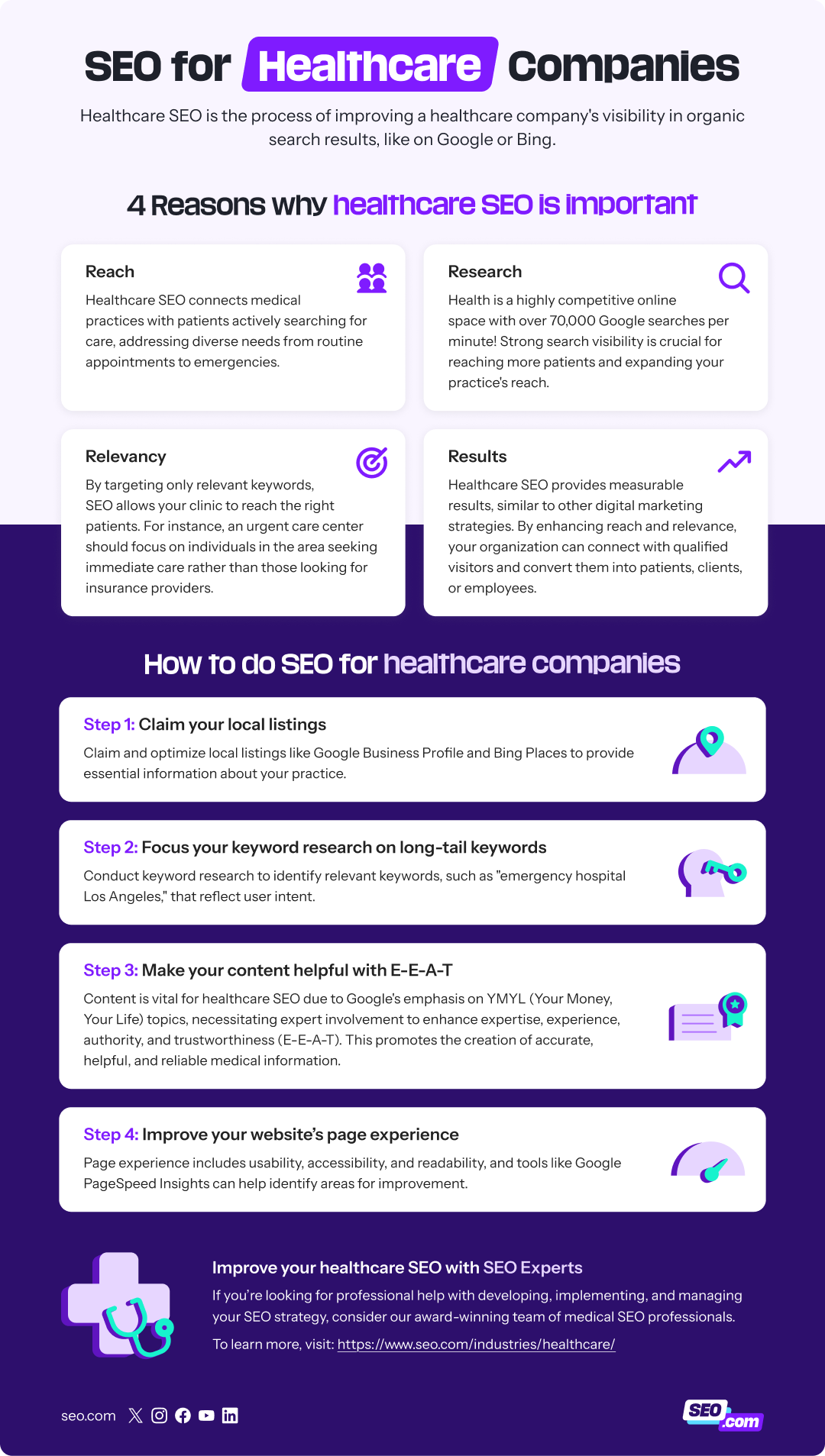
- What is Healthcare SEO?
- Why is Healthcare SEO Important?
- How is Medical SEO Different from SEO for Other Markets?
- How to Do SEO for Healthcare Companies
- Step 1: Claim Your Local Listings
- Step 2: Focus Your Keyword Research on Long-tail Keywords
- Step 3: Make Your Content Helpful with E-E-A-T
- Step 4: Improve Your Website’s Page Experience
- Step 5: Secure Your Site with HTTPS
- Step 6: Streamline Your Website Architecture
- FAQs About Outsourcing Medical SEO
SEO Services That Aren't Cookie Cutter
Get an SEO strategy that's tailored for your business, industry, and revenue goals.
Writers

Stephen Aloy
Lead SEO Consultant, WebFX
Stephen Aloy
Lead SEO Consultant, WebFX
Dive Deeper
Health Care
Lorem ipsum dolor sit amet, consectetur adipiscing elit. Ut elit tellus, luctus nec ullamcorper mattis, pulvinar dapibus leo.
Pest Control
Lorem ipsum dolor sit amet, consectetur adipiscing elit. Ut elit tellus, luctus nec ullamcorper mattis, pulvinar dapibus leo.
HVAC
Lorem ipsum dolor sit amet, consectetur adipiscing elit. Ut elit tellus, luctus nec ullamcorper mattis, pulvinar dapibus leo.
Manufacturing
Lorem ipsum dolor sit amet, consectetur adipiscing elit. Ut elit tellus, luctus nec ullamcorper mattis, pulvinar dapibus leo.
Dental
Lorem ipsum dolor sit amet, consectetur adipiscing elit. Ut elit tellus, luctus nec ullamcorper mattis, pulvinar dapibus leo.
Education
Lorem ipsum dolor sit amet, consectetur adipiscing elit. Ut elit tellus, luctus nec ullamcorper mattis, pulvinar dapibus leo.
Transportation
Lorem ipsum dolor sit amet, consectetur adipiscing elit. Ut elit tellus, luctus nec ullamcorper mattis, pulvinar dapibus leo.
Finance
Lorem ipsum dolor sit amet, consectetur adipiscing elit. Ut elit tellus, luctus nec ullamcorper mattis, pulvinar dapibus leo.
Local Business
Lorem ipsum dolor sit amet, consectetur adipiscing elit. Ut elit tellus, luctus nec ullamcorper mattis, pulvinar dapibus leo.
Franchise
Lorem ipsum dolor sit amet, consectetur adipiscing elit. Ut elit tellus, luctus nec ullamcorper mattis, pulvinar dapibus leo.
What Is Pest Control SEO?
Pest control SEO is the process of improving a pest control company’s visibility in Google Search, Google Maps, AI search engines, and local search results so homeowners and commercial property managers can find the business when they need pest-related services.
The goal extends beyond generating one-time treatments.
Effective pest control SEO focuses on acquiring recurring service-plan customers, increasing customer lifetime value, and building a sustainable source of qualified leads.
A modern pest control SEO strategy typically includes:
- Google Business Profile optimization
- Local SEO
- Pest-specific landing pages
- Service-area content
- Review generation
- Technical SEO
- Schema markup
- AI search optimization
- Recurring-plan conversion optimization
Unlike many home service industries, pest control has unique search behavior that directly affects SEO strategy.
Dimension | Pest Control SEO | General Home Services SEO |
Revenue Model | Recurring service plans with long customer lifetimes | Often one-time projects |
Seasonality | Strong pest-specific seasonal demand | More stable throughout the year |
Service Variety | Dozens of pest categories | Smaller service catalogs |
Informational Searches | High pest-identification demand | Lower informational demand |
Commercial Contracts | Common in many markets | Less common |
Wildlife Services | Frequently overlaps with pest operations | Rare |
Because of these differences, SEO for exterminators requires a more specialized approach than traditional local SEO.
For broader local SEO principles, see our local SEO guide. For small-business SEO fundamentals, see our SEO for SMBs guide.
Why Pest Control SEO Matters in 2026
Pest control SEO matters because customer lifetime value in this industry is exceptionally high, paid acquisition costs continue to increase, and AI search is changing how people identify pests and choose providers.
Companies that rely exclusively on Google Ads or Local Services Ads face rising acquisition costs every year.
Meanwhile, competitors investing in SEO for pest control companies continue building organic visibility that generates leads without paying for every click.
Three factors make pest control SEO particularly valuable.
Recurring Revenue Changes the Math
Most local businesses calculate marketing performance based on the value of a single sale.
Pest control operators should calculate value based on customer lifetime revenue.
A homeowner enrolled in a quarterly prevention plan may generate hundreds of dollars annually and remain a customer for years. That means even moderate improvements in lead generation can create significant long-term revenue growth.
This recurring-revenue model is one of the biggest advantages of pest control marketing SEO.
Paid Advertising Costs Keep Rising
Pest control is one of the more competitive home-service categories in paid search.
Common keywords such as:
- Pest control near me
- Termite treatment
- Bed bug exterminator
- Rodent removal
can cost tens of dollars per click in competitive markets.
Unlike paid traffic, organic visibility continues generating leads after rankings are established, making pest control SEO services increasingly attractive for long-term growth.
AI Search Is Influencing Pest Identification
Consumers are no longer relying exclusively on Google.
Many homeowners now upload photos to ChatGPT, Gemini, Google Lens, and other AI tools to identify insects, rodents, and wildlife before contacting a service provider.
After identifying the pest, they often ask:
- Is this dangerous?
- How do I get rid of it?
- Should I hire a professional?
- Who is the best pest control company nearby?
Businesses that invest in AI visibility are increasingly appearing in those recommendation pathways.
For pest control companies, AI search is becoming an extension of local SEO rather than a separate channel.
The Pest Seasonality Framework
Seasonality is one of the most overlooked aspects of pest control SEO.
Pest activity follows predictable annual cycles. Search demand follows those same cycles.
Companies that create content after demand spikes are already behind competitors who prepared months earlier.
The most effective pest control SEO strategy aligns content production with seasonal demand before peak activity begins.
Termite Season (March–May)
Spring warming triggers termite swarms across many regions.
Search demand typically increases for:
- Termite treatment
- Termite inspection
- Termite swarm
- Signs of termites
Because termite-related services often carry high ticket values, these searches frequently have strong commercial intent.
Content should ideally be published during January and February to allow time for indexing and ranking.
Mosquito Season (May–September)
Mosquito demand increases as temperatures rise.
Popular searches include:
- Mosquito control near me
- Yard mosquito treatment
- Mosquito spraying service
- Mosquito prevention plans
Recurring mosquito treatment programs often perform particularly well because homeowners seek ongoing protection throughout the outdoor season.
Publishing content during late winter and early spring provides the best opportunity to capture summer demand.
Rodent Season (September–November)
As temperatures decline, rodents move indoors.
This creates increased search activity for:
- Mouse exterminator
- Rat removal
- Rodent control
- Mouse infestation signs
Content targeting rodent issues should ideally be published several months before fall demand peaks.
Bed Bug Season (Year-Round With Summer Peaks)
Bed bug searches occur throughout the year but typically increase during peak travel periods.
Important searches include:
- Bed bug treatment
- Bed bug exterminator
- Signs of bed bugs
- Hotel bed bugs
Because infestations spread quickly, these searches often carry urgent commercial intent.
Ant Season (March–October)
Ant-related searches provide consistent traffic across much of the year.
Depending on the region, firms may target:
- Carpenter ants
- Fire ants
- Pavement ants
- Ant extermination
For many pest control companies, ant-related content becomes a dependable source of year-round lead generation.
Wasp and Hornet Season (July–September)
Late summer produces strong demand for:
- Wasp removal
- Hornet nest removal
- Yellow jacket exterminator
These searches frequently convert well because of immediate safety concerns.
Off-Season Opportunities
Slower months should not be viewed as inactive months.
They provide opportunities to:
- Expand content libraries
- Improve technical SEO
- Build backlinks
- Update service pages
- Strengthen local SEO signals
- Prepare content for upcoming seasons
Companies that plan ahead consistently outperform businesses that react after demand appears.
The 7 Pillars of Pest Control SEO
Every successful pest control SEO strategy is built on seven foundational pillars.
When one pillar is neglected, overall performance suffers.
1. Google Business Profile and Local Services Ads
For most pest control companies, Google Business Profile remains the most important local SEO asset.
Map Pack visibility often drives more calls than traditional organic rankings.
A properly optimized profile should include:
- Correct categories
- Accurate business information
- Seasonal posts
- Service details
- High-quality photos
- Messaging functionality
- Consistent review generation
Local Services Ads should also be viewed as a complementary visibility channel rather than a replacement for SEO.
2. Pest-Specific Landing Pages
Most pest control websites dramatically underutilize service-page opportunities.
Instead of broad service pages, companies should create dedicated pages for individual pests, including:
- Termites
- Ants
- Rodents
- Bed bugs
- Mosquitoes
- Cockroaches
- Fleas
- Ticks
- Wasps
- Spiders
Dedicated pages allow businesses to rank for highly specific searches while providing better information for users.
This is one of the highest-impact improvements most SEO for pest control companies can make
Pest Control SEO for Different Business Models
Generic pest control SEO advice rarely works across every business model. Customer behavior, sales cycles, service economics, and competition vary significantly between residential, commercial, franchise, wildlife, and specialty operators.
1. Residential General Pest Control
Residential pest control companies rely heavily on recurring service plans, local visibility, and review-driven conversions.
A strong SEO for pest control strategy focuses on:
- Google Business Profile optimization
- Pest-specific landing pages
- Service area coverage
- Recurring plan conversion funnels
- Ongoing review generation
Most operators should build pages for every major pest they treat rather than relying on a single services page.
Because customer lifetimes often extend five years or more, even modest organic growth can generate substantial long-term revenue.
2. Residential Specialty Pest Control
Specialty operators focus on specific pest categories such as termites, bed bugs, mosquitoes, or wildlife.
Instead of broad coverage, pest control SEO should emphasize expertise and authority.
Key content assets include:
- Pest identification guides
- Treatment comparisons
- Prevention resources
- Case studies
- Warranty and guarantee information
Higher-ticket services often justify larger SEO investments because customer values are significantly higher.
3. Commercial Pest Control
Commercial pest control SEO looks more like B2B marketing than traditional local SEO.
Target audiences include:
- Facility managers
- Property management firms
- Healthcare facilities
- Restaurants
- Hospitality operators
- Manufacturers
Successful campaigns focus on:
- Compliance-related content
- Integrated Pest Management (IPM) resources
- Commercial case studies
- Industry-specific service pages
- Long-form educational content
Because commercial contracts often take months to close, SEO performance should be measured against pipeline growth rather than immediate leads.
4. Multi-Location Franchises and Chains
Multi-location brands face unique SEO challenges.
Success depends on:
- Individual Google Business Profiles for every location
- Consistent citations
- Location-specific content
- Scalable reputation management
- Strong local relevance within a centralized brand structure
For large operators, local optimization at each branch often drives more growth than broad national rankings.
5. Wildlife and Exclusion Services
Wildlife removal companies operate in a related but distinct category.
Search demand is often emergency-driven, with customers seeking immediate help for:
- Raccoons
- Squirrels
- Bats
- Snakes
- Opossums
SEO for exterminators in this niche should emphasize emergency response, humane removal, exclusion services, and repair solutions that prevent future infestations.
6. Fumigation and Specialty Treatments
Fumigation providers and specialty treatment companies compete on technical expertise and high-value projects.
SEO should focus on:
- Treatment methodologies
- Equipment and technology
- Preparation guides
- Post-treatment expectations
- Pricing transparency
- Before-and-after case studies
Because projects are often worth thousands of dollars, educational content plays a major role in lead generation.
How AI Search Engines Are Changing Pest Discovery
Pest discovery is increasingly happening through AI tools rather than traditional search alone.
Homeowners now use ChatGPT, Gemini, Perplexity, and Google Lens to:
- Identify insects
- Diagnose infestations
- Compare treatment options
- Find local providers
Instead of searching “carpenter ant treatment,” users ask detailed questions such as:
“I found large black ants near my window. What are they and how do I get rid of them?”
This shift rewards businesses that publish clear, structured, educational content.
To improve AI visibility, pest control companies should focus on:
Strong Organic Rankings
Traditional pest control SEO remains the foundation for AI visibility. Most AI systems cite pages already performing well in organic search.
Pest Identification Content
Create dedicated pages for major pest types with:
- Identification guidance
- Behavioral information
- Damage risks
- Treatment recommendations
Comprehensive Schema Markup
Implement:
- LocalBusiness Schema
- Service Schema
- FAQPage Schema
- Offer Schema
Structured data helps AI systems understand services and locations.
Strong Third-Party Signals
Reviews and citations across platforms such as Google, Yelp, BBB, Angi, and industry directories reinforce trust and authority.
Definition-First Content
Pages that answer key questions immediately are more likely to appear in AI-generated responses.
Active Review Profiles
Recent reviews with detailed customer experiences strengthen both local SEO and AI citation potential.
8 Pest Control SEO Mistakes to Avoid
These are the most common issues we uncover during pest control SEO audits.
1. Using One Services Page
Each major pest should have its own optimized landing page.
2. Publishing Thin Location Pages
City pages need unique local information, not simple city-name replacements.
3. Focusing Only on One-Time Jobs
Recurring service plans should be a primary conversion goal across the site.
4. Publishing Seasonal Content Too Late
Create seasonal content months before demand peaks.
5. Sharing Google Business Profiles
Every physical location should have its own GBP.
6. Ignoring Review Volume
Many competitors have hundreds of reviews. Low review counts limit local visibility.
7. Overlooking AI Search
Pest identification and treatment questions are increasingly happening through AI platforms.
8. Treating SEO as a Project
Pest control SEO requires continuous optimization, review generation, content updates, and local SEO maintenance.
How to Choose a Pest Control SEO Partner
If you’re outsourcing SEO for pest control companies, evaluate partners using the following criteria.
Industry Experience
Look for experience with pest control, exterminator, or home service businesses.
Multi-Location Expertise
Important for franchises and operators with multiple branches.
Recurring-Revenue Understanding
The best partners optimize for customer lifetime value, not just lead volume.
Local Services Ads Knowledge
SEO and LSA often work best together.
Review Management Systems
Review generation should be part of the process, not an afterthought.
AI Search Strategy
Ask how the agency approaches AI visibility and citation opportunities.
Realistic Timelines
Most campaigns see meaningful progress within 3–6 months, with stronger results over 6–12 months.
Transparent Pricing
Pricing should align with market competition, service area size, and business goals.
Frequently Asked Questions
How long does pest control SEO take?
Most businesses see local SEO improvements within 1–2 months and meaningful organic growth within 3–6 months. Competitive markets often require 6–12 months.
How much does pest control SEO cost?
Most pest control SEO services range from $1,500 to $10,000+ per month depending on competition, market size, and business model.
Why is pest control SEO different from other home services?
Pest control relies heavily on recurring revenue, pest-specific seasonality, and informational searches related to pest identification.
How do I improve service plan conversions?
Prominently feature recurring plans, explain long-term savings, compare package options, and make enrollment simple across the website.
What’s the difference between residential and commercial pest control SEO?
Residential SEO focuses on local searches and homeowners. Commercial SEO targets businesses, facilities, and property managers with longer sales cycles.
How do pest control companies appear in AI search results?
Strong organic rankings, pest-specific content, structured data, reviews, and authority signals improve visibility in AI-generated recommendations.
Should I invest in SEO or paid ads?
The strongest approach combines both. Paid ads provide immediate leads, while pest control SEO creates long-term organic growth and lower acquisition costs over time.
Your Next Steps
You now have the complete SEO for pest control framework.
To start generating more recurring-revenue customers:
- Audit your current website against the 7 pillars.
- Expand pest-specific landing page coverage.
- Improve Google Business Profile optimization.
- Strengthen review generation systems.
- Build city-plus-pest content assets.
- Implement structured data across key pages.
- Develop seasonal content before peak demand periods.
- Add AI search optimization to your broader pest control SEO strategy.