
SEO for Franchises: The Complete 2026 Guide for Multi-Location Brands

Table Of Content
- What Is Franchise SEO?
- Why Franchises Need SEO in 2026
- How Franchise SEO Is Different from Generic SEO
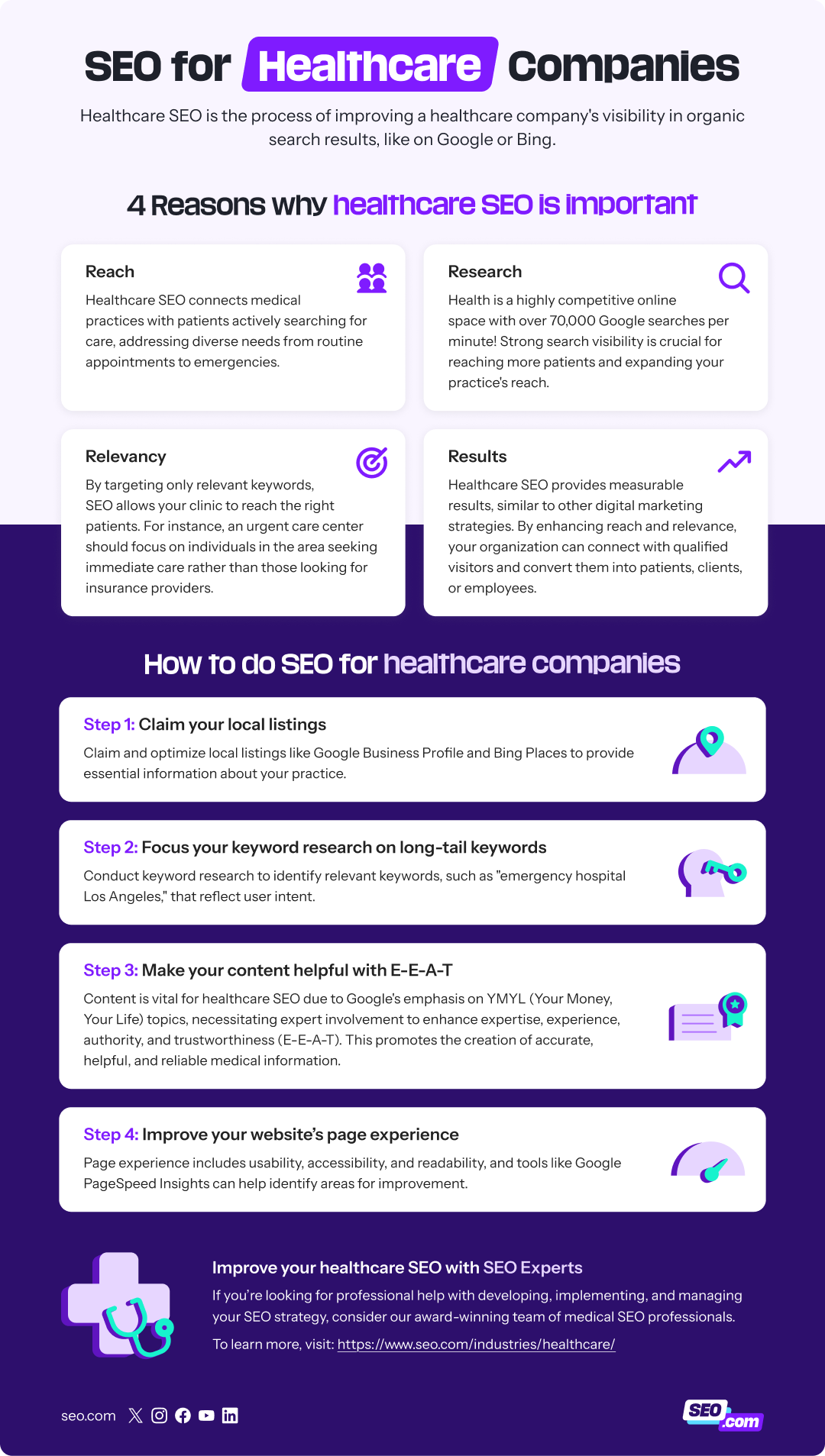
- How to Do SEO for Healthcare Companies
- The 7 Pillars of Franchise SEO
- SEO for Different Franchise Types
- How AI Search Engines Are Changing Franchise Discovery
- 8 Franchise SEO Mistakes to Avoid
- How to Choose a Franchise SEO Partner
- Frequently Asked Questions
SEO Services That Aren't Cookie Cutter
Get an SEO strategy that's tailored for your business, industry, and revenue goals.
What Is Franchise SEO?
Franchise SEO is the practice of optimizing a multi-location brand’s online presence so that the corporate site builds national authority while every individual location ranks for its own local searches, all without tripping duplicate-content filters or violating brand standards.
It combines parent-child site architecture, Google Business Profile management at scale, NAP consistency across hundreds of directories per location, and increasingly, optimization for AI search engines that consumers now use to find supplier and service recommendations.
Franchise SEO sits at the intersection of three established disciplines but is its own category. While it shares foundations with SEO basics, on-page SEO, technical SEO, and off-page SEO, franchise brands face a unique combination of pressures:
- Two simultaneous SEO targets: Corporate has to rank for brand-wide and category-level searches. Each location has to rank for “near me” and city-specific searches inside its own market. The strategies for each are different and have to coexist on one website.
- Duplicate content risk at every location: When 100 location pages all say roughly the same thing about the same services, Google sees duplicate content and rankings collapse. Avoiding this at scale is a structural challenge, not a writing problem.
- Franchisor vs. franchisee tension: Corporate wants brand consistency. Individual franchisees often want freedom to run local promotions, optimize their own listings, and adapt messaging to local markets. SEO has to work inside that tension.
- Co-op marketing fund dynamics: Most franchise systems pool a percentage of franchisee revenue into a marketing fund. SEO budgets often have to be approved through that structure, which affects how programs get scoped and rolled out.
For broader local SEO work outside of multi-location brands, see our local SEO guide and local SEO services pages.
Why Franchises Need SEO in 2026
Franchises need SEO because nearly every consumer journey now starts with a search, and franchise brands that fail to dominate both brand-level and location-level search results lose market share to competitors who do, including independent local operators that can outrank entire national chains in their own markets.
Three reasons the work pays off:
- Local search converts faster than almost any other channel. Roughly three out of four mobile local searches result in a store visit within 24 hours. For franchises with physical locations, every “near me” search that ranks a competitor instead of you is a customer who walked into someone else’s location.
- Brand authority compounds across all locations. When the corporate domain builds strong topical authority, every location page benefits. A franchise that invests in centralized SEO content sees individual locations climb in their local markets without each franchisee having to fund standalone campaigns.
- AI search has become a real channel. Consumers are increasingly asking ChatGPT, Gemini, and Perplexity for recommendations: “what’s a good fitness studio near me,” “find me a reliable plumbing service in Phoenix,” “best math tutoring program for kids.” Franchise brands that show up in those AI answers capture a growing share of early-stage research before traditional search even happens.
How Franchise SEO Is Different from Generic SEO
Most SEO advice is written for single-location businesses, ecommerce stores, or general B2B SaaS. Franchise SEO has its own dynamics:
- Architecture decisions cascade to every location. A small structural mistake on a single-location website affects one site. The same mistake on a franchise website affects 100 or 1,000 location pages simultaneously. Architecture has to be right from the start.
- Volume is not the right keyword metric. A keyword searched 200 times a month inside one franchise market matters more than a keyword searched 20,000 times a month at the national level if the local one drives conversions. Local keyword volume across the full footprint is the real measure.
- Scale changes everything operational. Updating hours on one Google Business Profile is a five-minute task. Updating hours on 500 profiles requires a system. Franchise SEO is as much an operations problem as a marketing one.
- Location pages are the conversion engine. Most franchise leads convert on a location page, not the homepage. Each location page has to function as a complete landing page for local search intent.
- Brand consistency competes with local relevance. Franchisees often want to run local promotions, change messaging for local markets, or optimize their own GBP listings. SEO has to enable enough flexibility for local relevance while protecting brand standards.
The 7 Pillars of Franchise SEO
1. Brand vs. Location Architecture
Brand vs. location architecture is the structural decision about how the corporate website handles location-specific content, typically following a parent-child model where the corporate domain hosts location pages at predictable URLs like /locations/[city]/[neighborhood]/.
This is the single most important structural decision in franchise SEO. The most common architecture is a single corporate domain with location pages nested at /locations/, but some franchise systems use subdomains per location, and others let franchisees run independent websites.
Each model has trade-offs in authority distribution, content control, and operational complexity. The right answer depends on franchise system size, franchisee autonomy, and brand standards. Get this wrong at the start and every other pillar struggles.
2. Google Business Profile Management at Scale
Google Business Profile management at scale is the operational practice of maintaining accurate, complete, optimized GBP listings for every individual franchise location, with no shortcuts and no shared profiles. Each location needs its own GBP.
Each profile has to be claimed, verified, fully completed, and consistently updated with hours, services, photos, posts, and Q&A responses. At 100+ locations, this becomes a real operational program requiring dedicated tools, clear ownership, and regular audits.
Many franchise systems use platforms like Yext, Uberall, Birdeye, or SOCi to manage profiles at scale, but the platform alone is not the answer. The discipline behind it matters more.
3. NAP Consistency Across Citations
NAP consistency means that every location’s Name, Address, and Phone number is identical across every directory, citation, and listing on the web. A franchise location often appears on 100 to 300 different directories, from major platforms like Google, Apple Maps, Bing Places, and Yelp down to industry-specific sites.
Inconsistent NAP across these citations confuses search engines about which location is which and damages local rankings. Citation management tools help, but the underlying data has to be clean at the corporate level first. Sites with messy citation data across hundreds of locations rarely outrank competitors with clean data, even when the rest of their SEO is strong.
4. Unique Location Page Content
Unique location page content is the practice of writing genuinely distinct content for every location page, rather than templating identical content with only the city name swapped.
Google has gotten very good at detecting templated content, and franchise systems with 100 location pages that all say the same thing get filtered out of local search results.
Each page needs unique elements: location-specific photos, local team bios, local case studies or testimonials, neighborhood-specific service notes, local landmarks or context, hours that match local market norms, and ideally franchisee-contributed content.
Template-with-tokens approaches do not survive in 2026. Our SEO content guide covers the underlying framework.
5. Local Keyword Strategy Per Franchisee
Local keyword strategy per franchisee means building a unique keyword targeting plan for each location based on its specific market, competition, and service mix. A pizza franchise location in Manhattan competes against very different searches than the same franchise in suburban Phoenix.
Treating every location’s keyword strategy identically wastes effort on the wrong terms in every market. The right approach starts with national category keywords on the corporate site, then layers location-specific keyword research per franchisee to identify the actual searches in each market. Our keyword research guide covers the methodology.
6. Review and Reputation Management at Scale
Review and reputation management at scale is the operational practice of generating, monitoring, and responding to reviews across every franchise location, with consistent brand voice and timely response.
Reviews are a major local ranking factor, and review velocity (the rate at which a location gets new reviews) affects rankings even more than total review count.
Franchise systems need a unified approach: review request workflows triggered after every transaction, response guidelines for franchisees, escalation paths for negative reviews, and dashboards that surface review trends across the network.
Locations with strong, recent review activity consistently outrank locations with stale or negative review profiles.
7. AI Search Visibility for Franchise Brands
AI search visibility means structuring content so franchise brands get cited when consumers ask AI assistants for local recommendations.
Buyers are increasingly asking ChatGPT “what’s a good gym near me,” asking Gemini “find me a reliable home services company in Atlanta,” or asking Perplexity “best math tutoring for elementary kids.”
Franchise brands that show up in those AI answers capture a fast-growing share of early-stage research. Our guides to AI and SEO, AEO, and GEO cover the playbook.
SEO for Different Franchise Types
Generic franchise SEO advice does not work equally well across every type of franchise system. Each category has its own search behavior, conversion path, and competitive landscape.
Food and Restaurant Franchises
Food franchises live or die on “near me” searches. Whether the brand is a pizza chain, sandwich shop, fast-casual concept, or ice cream franchise, the typical customer journey starts with hunger and a phone.
Successful food franchise SEO emphasizes complete menu schema implementation, online ordering integration on every location page, accurate hours including delivery and pickup windows, photos of food and storefronts on every GBP, and rapid response to customer reviews about food quality.
Local search ranking for food is heavily influenced by Google Business Profile completeness and review velocity, often more than by traditional on-page factors.
Fitness Franchises
Fitness franchises (gyms, boutique studios, yoga, martial arts) compete on a combination of facility quality and conversion-funnel strength.
The customer journey usually involves multiple touchpoints: a “near me” search, a location page visit, a free trial signup, and an in-person tour. Successful fitness franchise SEO builds location pages around class schedules, instructor bios, free trial CTAs, and member testimonials.
Membership decisions often depend on perceived community fit, so genuine local content and franchisee-contributed photos and stories matter more than generic stock messaging. Brand-wide content can cover programs, methodology, and benefits while location pages handle the local conversion work.
Home Services Franchises
Home services franchises (plumbing, HVAC, restoration, lawn care, pest control, handyman) face strong emergency-driven search behavior. A burst pipe at midnight or a flooded basement creates urgent searches like “24 hour plumber near me” or “emergency restoration company.”
Successful home services franchise SEO emphasizes service-specific pages per location, clear emergency response messaging, service area definitions, seasonal content (winter pipe protection, spring lawn care, summer HVAC tune-up), and trust signals like licensing, insurance, and warranty information. Speed of response from inquiry to scheduled appointment is itself a conversion factor.
Retail Franchises
Retail franchises (convenience stores, supplement shops, hardware stores, mailing centers, vape shops) compete on a different mix: hours of operation, product availability, and convenience.
Successful retail franchise SEO focuses on accurate hours including holiday adjustments, product or service category pages per location, in-store pickup or curbside options, and clear payment and accessibility information.
Many retail franchise customers are decided buyers who searched for a specific product or service category, so getting the location page to surface for those category-plus-location searches matters more than building heavy informational content.
Automotive Franchises
Automotive franchises (oil change, brake service, tire shops, auto body, transmission specialists) face highly service-specific search behavior. Customers typically search for the exact service they need plus a location modifier: “oil change near me,” “brake repair Phoenix,” “tire rotation cost.”
Successful automotive franchise SEO builds service-specific pages per location with transparent pricing, appointment booking integration, mechanic credentials, and trust signals around warranties and certifications. Walk-in versus appointment behavior varies by service type, so calls-to-action have to match what each service category expects.
Education and Childcare Franchises
Education franchises (tutoring, STEM education, language learning, preschool, daycare, after-school programs) serve a parent audience making careful, research-heavy decisions. The typical buying journey can stretch over weeks and involves multiple consultations, site visits, and competitive comparisons.
Successful education franchise SEO builds detailed program pages by age group, curriculum explanation content, parent testimonials, accreditation and safety information, and clear trial or enrollment funnels.
Trust signals (licensing, teacher credentials, safety records) carry exceptional weight, and many parents specifically search for franchise brands they recognize from their own childhood or community word-of-mouth.
How AI Search Engines Are Changing Franchise Discovery
A growing share of consumer research now happens on AI search engines instead of traditional Google. Someone might ask ChatGPT “what’s a good fitness studio in Brooklyn that has classes after 6pm,” ask Perplexity “find me a reliable plumber for emergency repairs in Atlanta,” or get an AI Overview when searching Google for “best math tutoring for 7 year olds.”
To rank in these AI surfaces, a franchise brand needs:
- Strong organic Google rankings: Roughly 73% of websites cited inside Google AI Overviews also rank in the top 10 organic results. Traditional SEO is the foundation for AI visibility.
- Schema markup for every location: Implement LocalBusiness schema with full attributes per location, plus FAQPage and Service schema. Gemini in particular leans on structured data for local recommendations.
- E-E-A-T signals throughout the site: Real franchisee bios, licensing and certification information, brand history, and clear sourcing for any factual claims.
- Citations across local directories and publications: AI engines cross-reference brand mentions across the web. Franchise brands with strong presence in industry publications, local news coverage, and franchisee-specific directories are more likely to be cited than brands with thin off-site presence.
- Definition-first content structure on category pages: Content that opens with a clear, citable answer paragraph (what the franchise offers, where it operates, what makes it distinct) gets extracted into AI answers more reliably.
8 Franchise SEO Mistakes to Avoid
These are the issues we find most often when auditing multi-location franchise websites.
- Templated location pages with city tokens. Pages that say the same thing about the same services with only the city name swapped get filtered as duplicate content. Each page needs genuinely unique elements.
- Single Google Business Profile shared across locations. Each location needs its own GBP. Sharing one profile across multiple locations is a structural violation that caps every location’s rankings.
- Inconsistent NAP across citations. A franchise location with different addresses, phone numbers, or business names across major directories will not rank well in local search regardless of other SEO investment.
- No unique content on location pages. Many franchise sites have technically separate location pages but with identical content. Search engines treat these the same as a single duplicated page.
- Ignoring franchisee compliance. Franchisees who modify their websites, run unauthorized promotions, or create inconsistent local listings undermine the entire brand’s SEO. Compliance has to be built into the franchise operations program.
- Missing location schema. Failing to implement LocalBusiness schema with full attributes per location forfeits a major AI search visibility advantage and reduces rich result eligibility.
- No reputation management at scale. Locations with stale reviews or unaddressed negative reviews steadily lose ranking ground. Review velocity and response have to be operational, not ad-hoc.
- Treating SEO as a one-time setup. Franchise systems that built location pages two years ago and haven’t touched them since lose ground steadily as competitors update their content, expand their footprints, and improve their citation profiles.
How to Choose a Franchise SEO Partner
If you decide not to run franchise SEO in-house, the partner you choose matters as much as the work itself. Look for:
Multi-location and franchise experience specifically. A partner that has only worked with single-location businesses will struggle with the architectural and operational complexity of franchise SEO. Ask for case studies showing 20+ location systems, ideally in your category. The discipline is different enough that generalist agencies often underperform on franchise programs.
Scalable processes, not bespoke per location. The right partner has documented playbooks and tooling for citation management, GBP management, content production, and reporting that work the same way across every location. Bespoke approaches that treat each location as a custom project do not scale and burn out as the franchise system grows.
Franchisor and franchisee relationship management. Good franchise SEO partners understand the political dynamics between corporate and franchisees. They can present results to corporate while also working productively with individual franchisees, handle compliance issues sensitively, and structure programs that respect both audiences.
Co-op marketing fund expertise. Many franchise systems fund SEO through co-op marketing funds, which have specific approval, allocation, and reporting requirements. Partners who have worked inside that structure know how to scope and report programs that hold up to franchisee oversight.
AI search awareness. In 2026, any franchise SEO partner without a clear approach to AI search visibility (ChatGPT, Gemini, Perplexity citations) is working from an outdated playbook.
Realistic timelines. Franchise SEO produces early lift between months three and six, with compounding returns building through year one and beyond. Partners promising first-page rankings across all locations in 30 days are either selling paid ads, using black-hat tactics, or misrepresenting timelines.
Reasonable pricing. Franchise SEO programs typically range from $500 to $3,000 per location per month for distributed programs, or from $5,000 to $30,000 per month for centralized corporate programs covering the full system. See our SEO services pricing page for a full breakdown, or explore our managed SEO services to see how we structure franchise engagements.

Stephen Aloy
Lead SEO Consultant, WebFX
Stephen Aloy
Lead SEO Consultant, WebFX
Frequently Asked Questions
What is franchise SEO?
Franchise SEO is the practice of optimizing a multi-location brand’s website, location pages, and online presence so that the corporate domain builds national authority while each individual location ranks for its own local searches. It combines parent-child site architecture, Google Business Profile management at scale, NAP consistency across citations, unique location page content, local keyword strategy per franchisee, reputation management at scale, and increasingly, optimization for AI search engines.
How long does franchise SEO take to work?
Most franchise systems see early ranking improvements at the location level within three to six months, with meaningful traffic and lead growth between months six and twelve. Citation cleanup, GBP optimization, and review management can produce visible local impact within weeks. Compounding returns build through year one and continue as long as the SEO work continues. Larger franchise systems with 100+ locations often see results unfold in waves as the work rolls through the network.
How much does franchise SEO cost?
Franchise SEO programs typically range from $500 to $3,000 per location per month for distributed programs where each franchisee funds their own SEO, or from $5,000 to $30,000 per month for centralized corporate programs covering the full system. The cost depends on the number of locations, the depth of work per location, the competitive intensity in each market, and whether the work is funded centrally or distributed across franchisees. Our SEO services pricing page covers what each tier typically includes.
Should each franchise location have its own website?
Usually no, although some franchise systems do operate this way. The majority of effective franchise SEO programs use a single corporate domain with location pages at predictable URLs like /locations/[city]/[neighborhood]/. This concentrates authority, makes content management easier, and avoids the duplicate content risk that comes with multiple separate sites covering the same brand. Independent franchisee sites can work for franchise systems with high franchisee autonomy, but they require more careful coordination to avoid hurting the brand’s overall search presence.
How do I avoid duplicate content across franchise location pages?
Duplicate content across location pages is the single most common franchise SEO mistake. To avoid it, each location page needs genuinely unique elements: location-specific photos, local team bios, neighborhood-specific service notes or hours, local case studies or testimonials, franchisee-contributed content where possible, and unique meta titles and descriptions. Templates that only swap the city name across otherwise-identical content will not rank well in 2026.
Should each franchise location have its own Google Business Profile?
Yes, without exception. Each individual franchise location needs its own claimed, verified, and fully completed Google Business Profile. Sharing a profile across multiple locations is a violation of Google’s guidelines and severely caps local search rankings for every affected location. At scale, franchise systems use platforms like Yext, Uberall, Birdeye, or SOCi to manage GBPs across hundreds of locations, but the underlying principle is one location, one profile, no exceptions.
How do I handle franchisee compliance for SEO?
Franchisee SEO compliance starts with clear brand standards documented in the franchise operations manual: required NAP format, GBP management rules, website modification policies, review response guidelines, and approved local SEO tactics. The compliance program then needs operational support: regular audits, clear escalation paths for violations, training resources for franchisees who want to handle their own local SEO, and ongoing communication so franchisees understand why the standards matter for their own performance.
How do franchises show up in ChatGPT and AI search results?
To appear in AI search results, build strong organic Google rankings (since AI engines pull heavily from search results), implement LocalBusiness schema with full attributes for every location, publish definition-first content on category and location pages, earn citations across local directories and trade publications, ensure your robots.txt allows AI crawlers like GPTBot and PerplexityBot, and maintain strong review profiles across every location. Our AI and SEO guide covers the full playbook.